Uncertainty has a data type.
When the system is not sure, it does not improvise. Inferred claims carry escape hatches, and the pipeline routes low-confidence work to a person through named return states instead of guessing.
The Machinery
RSUA would rather spend a discovery call solving your problem than proving its claims. So the proof is here instead, in the open, where you can question it before we ever talk.
Every firm says it has a process. This page shows ours running: the review desk where a human decision gates every piece of work, and the inspection rig inside the assessment you can run on your own company. The numbers on this page are live operating figures, including the ones that show our work coming back for changes. We publish those because a quality system that never catches anything is not a quality system.
The Machinery
This is the review desk where RSUA's agent work queues for human judgment. Each packet arrives with its action path, acceptance checks, and artifacts. A person approves it, sends it back with changes, or fails it. Nothing ships on model confidence alone.
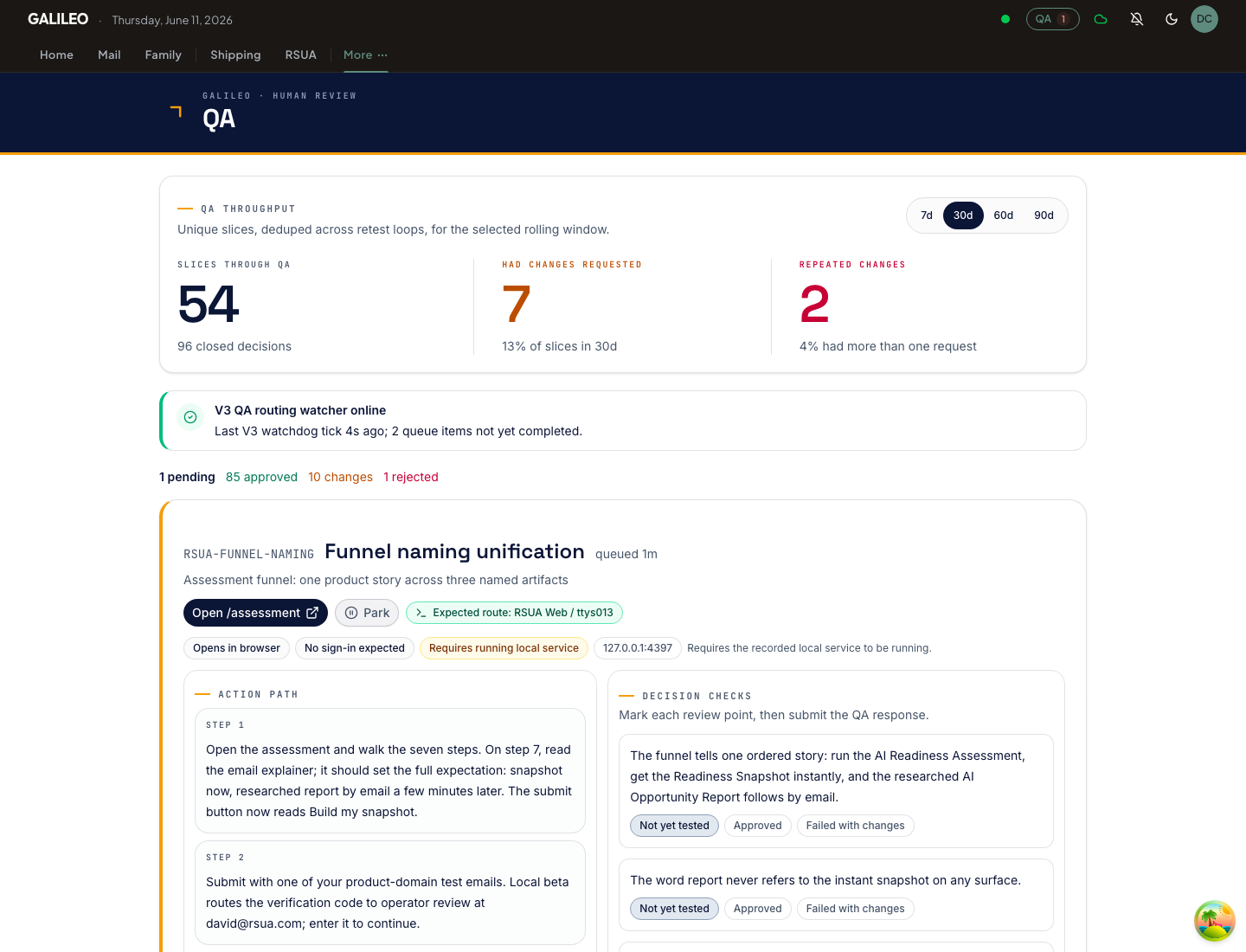
The changes-requested rate stays on the page. Agent work that never gets sent back means either perfection or a gate that is not really gating. We know which one we believe.
The Machinery
The readiness assessment on this site is built on the same discipline. Most of its code never touches the happy path. A few of the parts, visible:
When the system is not sure, it does not improvise. Inferred claims carry escape hatches, and the pipeline routes low-confidence work to a person through named return states instead of guessing.
Every generated report is scored across six dimensions before anyone sees it. Low uncertainty sends. Moderate uncertainty routes to human review. High uncertainty refuses to generate at all. The thresholds are calibrated against fixtures that fail the build if scoring drifts.
A held report does not sit in a queue hoping someone notices. It escalates on a ladder: push notification, retries, email, text message. Critical states are designed to find a human.
The report separates what the company says about itself, what independent sources say, and what employee sentiment suggests, and it labels its own confidence on each finding. Disagreement between sources is shown, not smoothed.
The Machinery
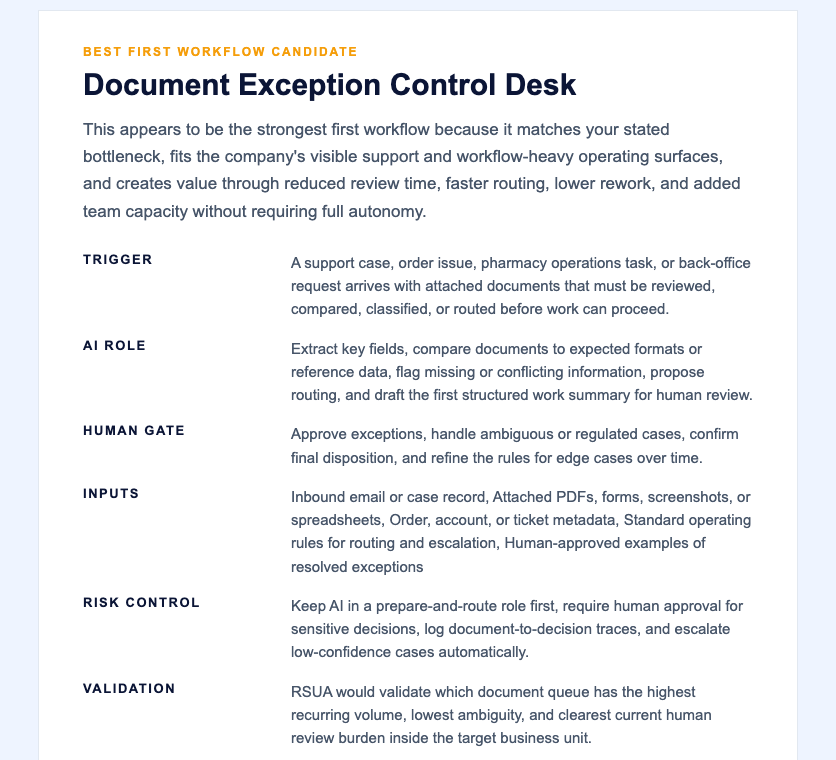
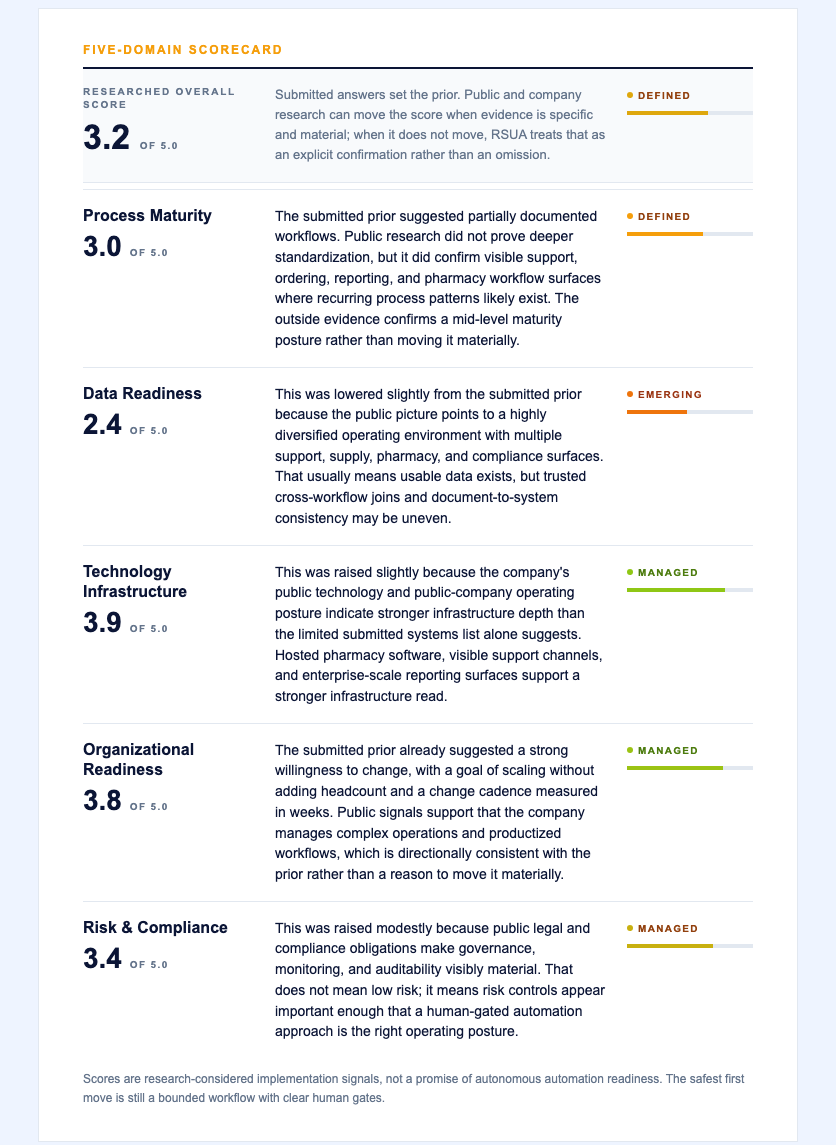
These samples show the operating questions the assessment has to answer before RSUA recommends a first build: which workflow should cross the first human gate, how ready the company appears, and which work should stay out of phase 1.
See the whole report.
Excerpts from a real generated report. The subject is a Fortune-scale healthcare distributor; the name and identifying details have been altered.
The crops are only inspection points. The full sample report shows the scorecard, workflow logic, defer list, and discovery handoff in context.
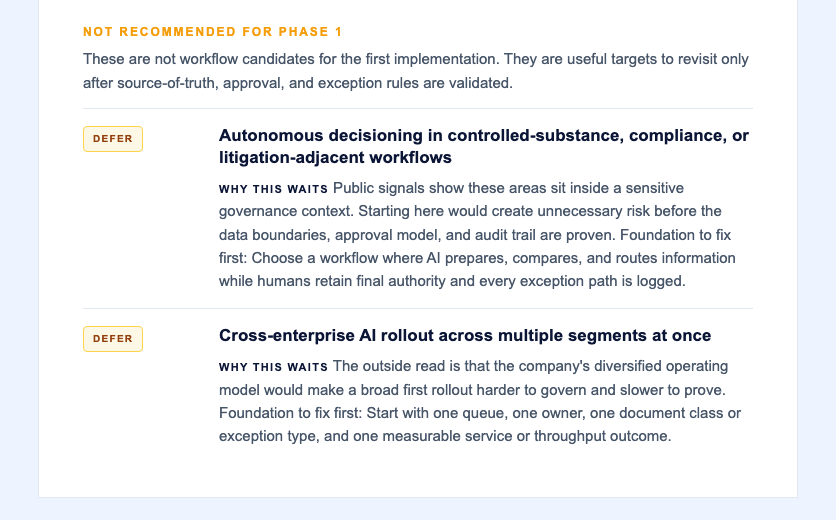
Why show what not to automate?
A useful assessment should not recommend everything. The defer list shows the work RSUA would keep out of phase 1 until the data boundaries, approval model, and audit trail are proven. The report tells prospects what NOT to automate yet. Ask any sales team how that line got past them. It did not have to get past anyone. The system that wrote it was designed by the people who wrote this page.
You have now seen the equipment. The assessment is the test drive.

AI Opportunity Report
Start with the workflow where the ROI case can be tested.
The AI Opportunity Report is built exactly the way these pages say AI should be built. It does not try to turn a whole company into an AI project. It looks for one workflow where the mechanical work can move to AI and the Human Workbench is clear. The report finds the strongest ROI case, estimates the value lever, and names the evidence that would prove it. The installed workflow measures whether the case is real. That is how RSUA starts small without treating the first workflow as the finish line.